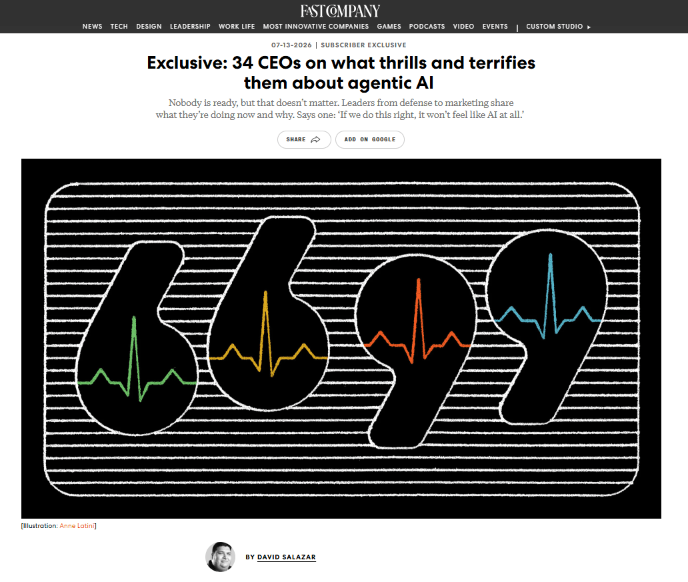
I was pleased to contribute my perspective alongside CEOs from companies including SEPHORA, American Express, Rocket, Anduril Industries, and many others in Fast Company‘s latest look at what excites and concerns leaders about agentic AI.
Thank you to David Salazar and Jay Woodruff for including me in such a thoughtful collection of viewpoints.
Having helped lead the development of Ralph Lauren‘s consumer-facing styling agent, Ask Ralph, and now spending time with retailers discussing their agentic commerce strategies, my perspective in this article focused on a different challenge: the organizational implications of internal AI agents.
Most companies are asking:
How, where, and how fast can we deploy AI agents?
What they should really be asking is:
▫️ Who decides where agents are used?
▫️ Who owns the outcomes?
▫️ Which platforms become enterprise standards for agentic AI?
▫️ Where does individual empowerment end and enterprise governance begin?
To me, the conversation around agentic AI is becoming less about technology and more about accountability.
As Taryn Crouthers, CEO of Big Spaceship, observed in the article:
“Some organizations are deploying agentic AI on top of org charts and data infrastructure that were never designed for it.” I couldn’t agree more.
Most organizations are still trying to establish governance for “regular” AI. Agentic AI increases the challenge because it can execute work on behalf of people. Without clear ownership and decision rights agentic AI can create an accountability vacuum.
The competitive advantage won’t come from having more agents. It will come from knowing exactly who owns them and who is accountable for them.
https://www.fastcompany.com/91549056/ceo-survey-agentic-ai-promise-fears