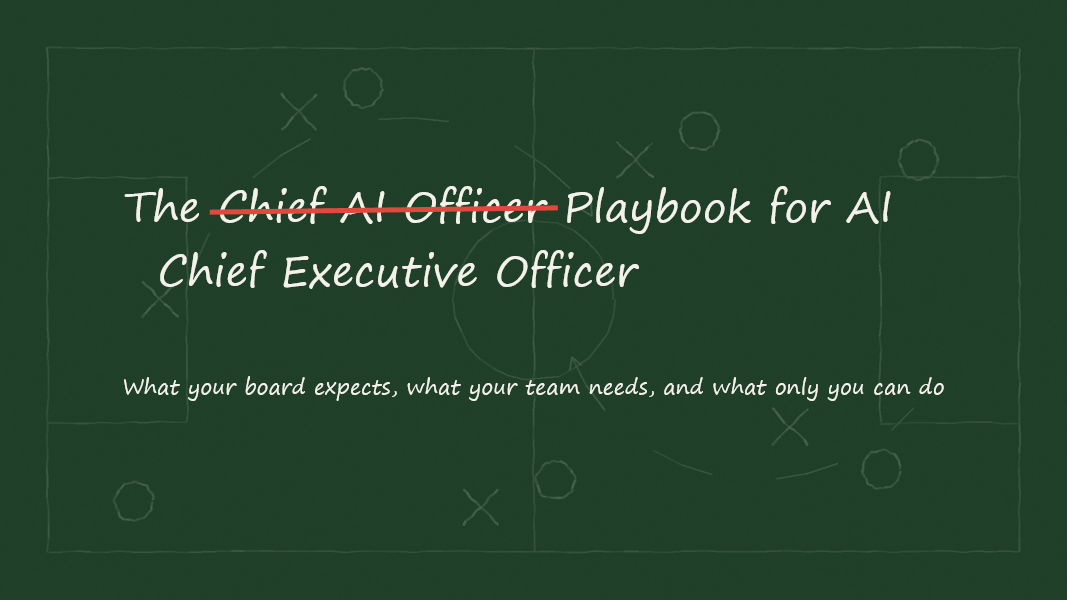
Major consulting firms increasingly seem to think so. The pendulum has clearly shifted from “Every company needs a CAIO” to “The CEO must lead AI.”
As someone who has long questioned the reflex to create a new executive role for every new enterprise priority, I welcome the shift.
But I think calling the CEO the Chief AI Officer goes a bit too far.
The CEO’s essential role is to serve as the company’s advocate and champion for AI, and to ensure that the board, executive leadership team, and workforce share the same definitions and understanding of the company’s AI strategy.
A complete enterprise AI strategy has five elements:
1️⃣ The operating model—who is accountable for what
2️⃣ The high-level technology strategy
3️⃣ Prioritization and investment process
4️⃣ Success measures
5️⃣ Governance
The CEO must ensure that these five elements form one coherent enterprise strategy. But that does not mean the CEO personally owns or manages all five.
The CIO or CDTO should typically own the technology strategy. Business and functional leaders should own their AI priorities and outcomes. The CFO should help establish investment discipline and credible measures of value. Legal, security, risk, and audit should own critical aspects of governance.
The CEO owns something different that is indispensable: 𝗧𝗵𝗲 𝗼𝗽𝗲𝗿𝗮𝘁𝗶𝗻𝗴 𝗺𝗼𝗱𝗲𝗹.
Only the CEO can resolve competing claims of ownership across the executive team. Only the CEO can ensure that accountabilities are explicit, enterprise capabilities are not fragmented, and every leader understands where their authority begins and ends.
I discussed this distinction in a CEO session at National Retail Federation Nexus last week. My central message was simple: The board can endorse the AI strategy. The executive team can execute it. Employees can adopt it. But only the CEO can ensure that all three groups are hearing—and acting on—the same strategy.
The CEO’s job is not to own every element of AI.
It is to ensure that every element has an accountable owner.